


 95 stations/collectes
SAYA
Informations générales
Date et lieu de départ
30/10/2022Date et lieu d'arrivée
23/11/2022Navire : Agulhas II
Objectifs :
Inventory of the benthic biodiversity:
Age, isolation, surface area: all these elements support the hypothesis that Saya de Malha would be an important centre of speciation and endemism of marine fauna and flora in the Indian Ocean. And yet, our knowledge of the fauna of the Mascarene Plateau in general, and of Saya de Malha in particular, is limited. Only about thirty publications describing new taxa, i.e. about 50 marine species have been dedicated to this geographical area (mainly fish, molluscs and a few species of crustaceans - see bibliographical list in paragraph 13). This is the state of our knowledge of a tropical shoal the size of Switzerland. The inventory, which will be implemented within the framework of the Saya de Malha project, aims to enrich our knowledge of biodiversity and to discover unknown species.
Lire la suiteTravaux effectués :
Remerciements :
The SAYA expedition is part of the 2e leg of the “Indian Ocean 2022” survey operated by Monaco Explorations from October 30th to November 22th on SA Agulhas II. The MNHN team was in charge of the sampling and inventorying of benthic fauna and flora on the Saya de Malha bank under the terms of the supplementary agreement concerning the terms and conditions for sharing biological materials and benefits from scientific research conducted in a non-commercial context (MoU MNHN-JMA 1176-22). Authors are grateful to the Mauritius-Seychelles Joint Commission of the Extended Continental Shelf, the Department of Blue Economy (Republic of Seychelles) and the Department for Continental Shelf, Maritime Zones Administration & Exploration (Prime Minster’s Office, Republic of Mauritius) for their supports and assistance in granting the necessary authorization. Authors would like to thank F. Marsac (IRD) as scientific PI as well as the crew of SA Agulhas II for all logistic and technical aspects.
Bibliographie (6) [+] [-]
-
Chen C.L. & Chan T.Y. 2023. The use of three-dimensional uCT imaging technique in the description of a new species of Stenopus Latreille, 1819 (Decapoda: Stenopodidea: Stenopodidae), with a revised key to the species of Stenopus. Journal of Crustacean Biology 43(3): ruad041. DOI:10.1093/jcbiol/ruad041
Résumé [+] [-]Members of the shrimp genus Stenopus Latreille, 1819 generally inhabit shallow-water coral reefs. Individuals are colorful, with many of them highly sought in the aquarium trade. A recent biodiversity cruise to the Saya de Malha Banks in the western Indian Ocean collected a new species of Stenopus from rather deep waters, at 192–216 m depth. This species is unusual in having a long rostrum overreaching the scaphocerite and a red and white color pattern, unique for Stenopus. A badly damaged specimen from French Polynesia likely belongs to the new species. The characteristics of the new species are illustrated by X-ray microcomputed tomography images (uCT imaging), line drawings, and color photographs. A key is also provided for the 12 known species of Stenopus.
Campagnes accessibles citées (1) [+] [-]
Codes des collections associés: IU (Crustacés) -
Nappo A. & Cilia D.P. 2025. Taxonomic review of the genus Korrigania Sanders et al., 2020 including a new species description, with comments on Tritonoranella Oyama, 1964 (Gastropoda: Bursidae). Bollettino Malacologico 61(1): 18-55. DOI:10.53559/BollMalacol.2024.17
Résumé [+] [-]The taxonomic status of Korrigania Sanders et al., 2020, of the family Bursidae Thiele, 1925, is reviewed. Prior to the present work, the genus included five recent species that demonstrate considerable morphological variation. Herein, the new species Korrigania stefanoelisa n. sp., from New Caledonia and Vanuatu, is added, and K. vianelloi Cossignani, 2023, so far only known from the Philippines, is designated as synonym of K. awatii (Ray, 1950) n. syn. The main morphological characters of Korrigania are described, together with those of the species included. Bursa humilis Beu, 1981 and Bursa natalensis Coelho & Matthews, 1970 are accepted as Tritonoranella humilis (Beu, 1981) n. comb. and Tritonoranella natalensis (Coelho & Matthews, 1970) n. comb.
Campagnes accessibles citées (26) [+] [-]BATHUS 1, BATHUS 2, BATHUS 3, BATHUS 4, BENTHAUS, BIOCAL, BIOMAGLO, CONCALIS, EBISCO, EXBODI, HALICAL 1, KANACONO, KANADEEP, MADEEP, MUSORSTOM 4, MUSORSTOM 5, MUSORSTOM 6, MUSORSTOM 8, NORFOLK 1, NORFOLK 2, PANGLAO 2004, PANGLAO 2005, SAYA, TERRASSES, VAUBAN 1978-1979, VOLSMAR
Codes des collections associés: IM (Mollusques) -
Palacios Theil E. & Błażewicz M. 2024. Distribution of species in deep-sea biogeographic provinces and molecular phylogeny for the superfamily Neotanaoidea (Peracarida; Tanaidacea) indicate high levels of connectivity. Frontiers in Marine Science 11: 1395000. DOI:10.3389/fmars.2024.1395000
Résumé [+] [-]Here we analyze available recorded occurrences for species of Neotanaoidea, a deep-sea peracarid superfamily, in the frame of biogeographic bathyal, abyssal, and hadal provinces. In addition, we provide the first phylogeny based on molecular data for this group. Despite the existence of large knowledge gaps, the observed patterns reveal levels of connectivity across biogeographic provinces, oceans, and depths higher than initially expected for a superfamily consisting of relatively small deep-sea benthic invertebrates without a pelagic larval stage, and therefore hypothetically low mobility capabilities. We have detected neotanaid species with closely related populations across the Pacific Ocean or able to overpass a geographical barrier as significant as the Mid-Atlantic Ridge. Additionally, the molecular analyses expose the need for a taxonomic review of the four genera within Neotanaoidea. A search for better suited morphological and possibly ecological characters as diagnostic traits for genera and species should be undertaken, aiming at a better definition of the existing taxa and the description of new ones.
Campagnes accessibles citées (2) [+] [-]
Codes des collections associés: IU (Crustacés) -
Salazar-Vallejo S.I., Piotrowski C.N. & Paulay G. 2024. Revision of Iphione Kinberg, 1856 (Annelida, Aphroditiformia, Iphionidae). Zootaxa 5548(1): 1-84. DOI:10.11646/zootaxa.5548.1.1
Résumé [+] [-]The only revision of Iphione was made by Pettibone in 1986, who recognized four species including two newly described in that work: I. muricata (Savigny in Lamarck, 1818) (type species), I. ovata Kinberg, 1856, I. treadwelli Pettibone, 1986, and I. henshawi Pettibone, 1986. She included I. fimbriata de Quatrefages, 1866, I. glabra de Quatrefages, 1866, and I. fustis Hoagland, 1920 within I. muricata, and I. spinosa Kinberg, 1856 and I. hirotai Izuka, 1912 in I. ovata. Three other species were later added to the genus: I. reticulata Amoureux, Rullier & Fishelson, 1978 from the Red Sea, I. coriolis Hanley & Burke, 1991 from the Coral Sea, and I. malifera Piotrowski, 2014 from the Philippines. A recent contribution showed that I. ovata ranges from the Red Sea to the Eastern Pacific and includes I. spinosa and I. reticulata. Our objectives were to revise the genus, evaluating all species and describing new ones by assessing the relevance of morphological features, assisted in part with COI sequence data. We studied the morphology of type and non-type material from 18 institutions and sequenced 52 specimens representing 11 species. We found that the size and position of eyes, the size relationships between cephalic appendages, and the number of rows of macrotubercles in elytra vary with body size. The most relevant diagnostic features for species delineation, confirmed by genetic species delineation, are the type and size relationships of macrotubercles, the presence of fimbriae, the development of the basal tubercle of dorsal cirrophores, the type of neurochaetae (falcate versus acicular), and their tips (uni- vs bidentate; or simple vs hooded). We clarified the type species of the genus as I. ovata, and recognized 17 species, nine previously described and eight new. Our main results include: 1) the restriction of I. muricata; 2) the reinstatement of I. fimbriata including I. fustis; 3) redescriptions of I. coriolis, I. henshawi and I. treadwelli; and 4) the description of eight new species: I. ankeri sp. nov. from Guam, I. corbari sp. nov. from the Saya de Malha Bank, I. harrisae sp. nov. from French Polynesia, I. hourdezi sp. nov. from New Caledonia, I. hyndmani sp. nov. from Hong Kong, I. readi sp. nov. from the Red Sea (including many earlier records of I. muricata), I. richeri sp. nov. from New Caledonia, and I. wilsoni sp. nov. from Australia. Descriptions the eight newly described species include only one based upon a single specimen. Keys are included for the genera in the family, and species of Iphione.
Campagnes accessibles citées (9) [+] [-]
Codes des collections associés: IA (Annélides, Polychètes et Sipunculides) -
Vilvens C. 2024. New species and new records of Calliostomatidae (Gastropoda: Trochoidea) from Mozambique Channel, Madagascar, Réunion and Saya de Malha. Novapex 25(4): 173-200
Campagnes accessibles citées (8) [+] [-]
Codes des collections associés: IM (Mollusques) -
Wong M.K. & Chen W.J. 2024. Exploring the phylogeny and depth evolution of cusk eels and their relatives (Ophidiiformes: Ophidioidei). Molecular Phylogenetics and Evolution 199: 108164. DOI:10.1016/j.ympev.2024.108164
Résumé [+] [-]With 289 known species in 51 genera, the ophidiiform family Ophidiidae together with their relatives from the Carapidae (36 species in eight genera) of the same suborder Ophidioidei dominate the deep sea, but some occur also in shallow water habitats. Despite their high species diversity in the deep sea and wide bathymetric distributions, their phylogenetic relationships and evolution remain unexplored due in part to sampling difficulties. Thanks to the biodiversity exploratory program entitled “Tropical Deep-Sea Benthos” and joint efforts between Taiwan and French teams for sampling from different localities across the Indo-West Pacific over the last two decades, we are able to compile comprehensive datasets for investigations. In this study, 59 samples representing 36 of 59 known ophidioid genera are selected and used to construct a multi-gene dataset to infer the phylogenetic relationships of ophidioid fishes and their relatives. Our results reveal that the Ophidiidae forms a paraphyletic group with respect to the Carapidae. The four main clades of Ophidioidei resolved are the (1) clade comprising species from the subfamily Brotulinae; (2) clade that includes species in the genera Acanthonus and Xyelacyba; (3) clade grouping Hypopleuron caninum with species from the family Carapidae; and (4) clade containing the species in the subfamily Brotulotaenilinae, Neobythitinae (in part), and Ophidiinae. Accordingly, we suggest the following new revisions based on our results and proposed morphological diagnoses. The subfamily Brotulinae should be elevated to the family level. The genera Xyelacyba and probably Tauredophidium (unsampled in this study) should be included in the newly established family Acanthonidae with Acanthonus. The families Carapidae and Ophidiidae are re-defined. Our time-calibrated phylogenetic and ancestral depth reconstructions enable us to clarify the evolutionary history of ophidiiform fishes and infer past patterns of species distributions at different depths. While Ophidiiformes is inferred to have originated in shallow waters around 96.25 million years ago (Mya), the common ancestor to the Ophidioidei is inferred to have invaded the deep sea around 90.22 Mya, the dates coinciding with the global anoxic event of the OAE2. The observed bathymetric distribution patterns in Ophidioidei most likely point to the mesopelagic zone as the center of origin and diversification. This was followed by multiple events of depth transitions or range expansions towards either shallower waters or greater depth zones, which were likely triggered by past climate changes during the Paleogene-Neogene.
Campagnes accessibles citées (19) [+] [-]AURORA 2007, BIOMAGLO, BIOPAPUA, DongSha 2014, EXBODI, KANACONO, KANADEEP, KANADEEP 2, KAVIENG 2014, MADEEP, NanHai 2014, Restreint, PAPUA NIUGINI, SAKIZAYA 2019, SAYA, SPANBIOS, TAIWAN 2013, TARASOC, ZhongSha 2015
Codes des collections associés: IC (Ichtyologie)
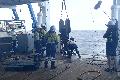
Liste des photos


Liste des participants

Détail :
- Bouchet, Philippe ( Muséum national d'Histoire naturelle)
- Tri, conditionnement Mollusques
- Corbari, Laure (Crustacés, Muséum national d'Histoire naturelle)
- Responsable Benthos, Coordination opérations de pêche
- Frutos, Inmaculada ( University of Lodz)
- Tri, conditionnement Crustacés
- Gouilleux, Benoît ( Université Bordeaux 1)
- Collecte en plongée, tri crustacés et annélides
- Hourdez, Stéphane ( Centre National de la Recherche Scientifique)
- Collecte en plongée, Annélides
- Le Gall, Line ( Muséum national d'Histoire naturelle)
- Responsable plongée, collecte en plongée, Algues
- Vassard, Emmanuel (Bénévole, Muséum national d'Histoire naturelle)
- Collecte en plongée
Cartographie des stations de collectes
 Fichier GoogleEarth (.kml) des points de collectes
Liste des stations

Taxons par accès
| Classe | Accès | Nombre de signalements |
|---|

